
Men’s Health
Low Testosterone
Testosterone drives energy, focus, muscle, and performance in every man. Testosterone levels naturally decline starting in your 30s, and symptoms like fatigue, weight gain, low libido, and weaker erections often follow. Testosterone replacement and hormone management require clinical expertise to deliver optimal results. Revibe’s TRT plans are designed specifically to address your symptoms and health concerns.

1 in 4
Men over 30 experience low testosterone
symptoms
Do You Recognize the Signs?
Low sex drive & weak erections
Fatigue & low energy
Loss of lean muscle or strength
Increased belly fat
Irritability or depression
Brain fog & poor focus
Learn More
Potential Benefits of Low Testosterone Treatment
More energy, stamina, and endurance
Improved libido and sexual performance
Increased lean muscle and reduced body fat
Sharper focus and better mood
Better sleep and sense of well-being
Better sleep and sense of well-being
Why revibe health
Personalized Low Testosterone Care Backed by Experience Since 2011
Revibe Health has provided personalized, clinician-guided care for hormone health, weight loss, sexual health, and wellness, built around each patient’s needs, goals, and lifestyle.
Care built around you
Comprehensive Evaluation
Labs + health history
Experienced Medical Care
Clinician-guided + monitored
Personalized Treatment
Built around your goals
treatment options
Explore Your Treatment
Hormone Optimization
Testosterone Cypionate Injections
Testosterone cypionate is a long-acting injectable that restores testosterone to healthy levels, typically dosed weekly. It rebuilds energy, strength, libido, and focus for men with Low-T. Revibe's providers customize your treatment based on your evaluation, lab work, health history and your goals, and will include training for easy at-home injection and ongoing support.
Testosterone cypionate is a long-acting injectable that restores testosterone to healthy levels, typically dosed weekly. It rebuilds energy, strength, libido, and focus for men with Low-T. Revibe’s providers customize your treatment based on your evaluation, lab work, health history and your goals, and will include training for easy at-home injection and ongoing support.
Hormone Optimization
Testosterone Cream
Testosterone cream is a needle-free way to restore healthy testosterone, applied once daily to mimic your body's natural rhythm. It's a simple option for men who prefer to skip injections. Revibe's providers customize your treatment based on your evaluation, lab work, health history and your goals.
Testosterone cream is a needle-free way to restore healthy testosterone, applied once daily to mimic your body’s natural rhythm. It’s a simple option for men who prefer to skip injections. Revibe’s providers customize your treatment based on your evaluation, lab work, health history and your goals.
Hormone Optimization
Clomiphene Citrate for Men
Compounded clomiphene citrate is a once-daily oral capsule that prompts your body to make more of its own testosterone instead of replacing it. By blocking estrogen feedback at the brain, it raises LH and FSH the hormones that tell the testes to produce testosterone and sperm. Revibe's providers may consider it for men who want to protect their fertility.
Compounded clomiphene citrate is a once-daily oral capsule that prompts your body to make more of its own testosterone instead of replacing it. By blocking estrogen feedback at the brain, it raises LH and FSH the hormones that tell the testes to produce testosterone and sperm. Revibe’s providers may consider it for men who want to protect their fertility.
Treatment Benefits and Timing
Low Testosterone Treatment (TRT) Benefits and Timing
While it is not uncommon for the body to require more time, anecdotally, many of our patients notice the benefits of testosterone replacement therapy in the first few weeks. More scientifically, a recent study in the European Journal of Endocrinology took a look at the benefits of testosterone replacement therapy, how far into therapy they typically first appear, and how long it takes to achieve their maximum benefits of their testosterone replacement therapy (TRT) treatment.
Testosterone Replacement Therapy Results and Timing
|
Therapy Result |
Time to Initial Results |
Time to Maximum Benefit |
|---|---|---|
|
Improved Libido |
3 Weeks |
6 Weeks |
|
Improved Mood |
3 Weeks |
2+ Years |
|
Improved Erections |
3 Weeks |
3-6 Months |
|
Improved Intimacy Satisfaction |
3 Weeks |
3-6 Months |
|
Improved Metabolism & Insulin Sensitivity |
3 Days |
3-12 Months |
|
Improved Cholesterol Levels |
4 Weeks |
1-2 Years |
|
Reduced Fat Mass |
12-16 Weeks |
12+ Months |
|
Increased Strength |
12-16 Weeks |
12+ Months |
|
Increased Lean Body Mass |
12-16 Weeks |
12+ Months |
|
Improved Bone Density |
6 Months |
3+ Years |
|
Reduced Inflammation |
3 Weeks |
12 Weeks |
condition treatments
Treatment Options for Low Testosterone
All treatment plans are prescribed by licensed providers following a comprehensive medical evaluation and diagnostic testing.
-
Testosterone Cypionate InjectionsTestosterone cypionate is a long-acting injectable that restores testosterone to healthy levels, typically dosed weekly. It rebuilds energy, strength, libido, and focus for men with Low-T. Revibe’s providers customize your treatment based on your evaluation, lab work, health history and your goals, and will include training for easy at-home injection and ongoing support.
-
Testosterone CreamTestosterone cream is a needle-free way to restore healthy testosterone, applied once daily to mimic your body’s natural rhythm. It’s a simple option for men who prefer to skip injections. Revibe’s providers customize your treatment based on your evaluation, lab work, health history and your goals.
-
Clomiphene Citrate for MenCompounded clomiphene citrate is a once-daily oral capsule that prompts your body to make more of its own testosterone instead of replacing it. By blocking estrogen feedback at the brain, it raises LH and FSH the hormones that tell the testes to produce testosterone and sperm. Revibe’s providers may consider it for men who want to protect their fertility.
The Revibe Health Approach
A Science-Based Approach to Low Testosterone Therapy (TRT)
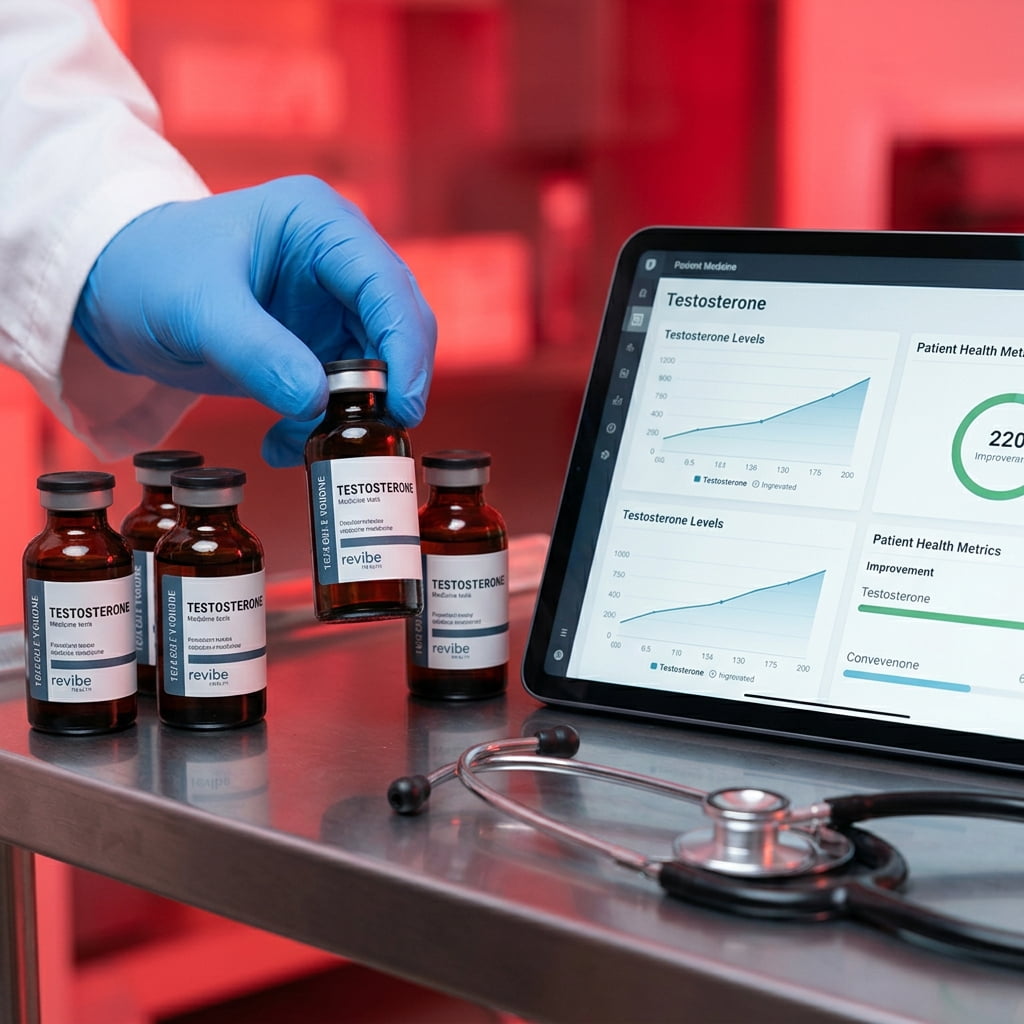
We believe that the best treatment is personalized medicine. That is why all our treatments start with a thorough, one-on-one evaluation with one of our medical providers. Our providers review your symptoms, health history and your health challenges and goals, and then develop a personalized treatment plan designed to effectively resolve your low testosterone levels and symptoms.
how it works
Your Path to Feeling Better.

step 01
Book a Consultation
step 02
Diagnostics First

testosterone
0.20
LOW
ng/dl
000 ng/dl
900 ng/dl

step 03
Your Treatment Plan
step 04
Ongoing Support

energy
this month
+25%
Weight : -12 lbs
Mood: +50%
frequently asked questions
Your Questions, Answered
Treatment Options at Revibe Health
TRT requires ongoing lab monitoring—typically testosterone levels, hematocrit, and PSA—with follow-up visits to adjust dosing. TRT treats Low-T but does not restart your body’s own production, so benefits generally last only while you continue treatment; if you stop, levels typically return to your pre-treatment baseline. Many men remain on monitored therapy long-term.
In men with confirmed Low-T, TRT can improve libido, energy, mood, lean muscle mass, and body composition. Effects appear on different timelines: research summarized in the European Journal of Endocrinology found improvements in libido and mood within about 3–6 weeks, improvements in erections over 3–6 months, and changes in fat mass, muscle, and bone density developing over months to years of consistent treatment.
Understanding Testosterone Replacement Therapy (TRT)
TRT is a medical treatment that restores testosterone to a healthy range in men whose bodies no longer produce enough of it, a condition called hypogonadism or “Low-T.” It is delivered in several forms most commonly weekly injections or a daily topical cream. Revibe’s licensed providers base every plan on your symptoms, lab work, and health history.
Low testosterone is confirmed with a blood test and an evaluation of your symptoms. The Endocrine Society recommends diagnosing Low-T only when a man has symptoms such as low libido, fatigue, reduced muscle mass, or erectile changes together with a low total testosterone measured using blood draws. Low-T symptoms can overlap with other conditions, which is why lab results are important when diagnosing low testosterone.
Testosterone in men peaks in early adulthood and then declines gradually research from the Massachusetts Male Aging Study found average total testosterone falls roughly 1–2% per year after about age 30. Decline can be accelerated by obesity, type 2 diabetes, chronic illness, certain medications, poor sleep, and problems affecting the testicles or the pituitary gland.
Revibe offers testosterone as injections (commonly testosterone cypionate, typically dosed weekly) and as a topical cream applied daily. Large clinical comparisons have found the main delivery methods to be similarly effective at raising testosterone; the right choice depends on your preferences, lifestyle, and how your body responds. Your Revibe Health provider will review the options with you.
Testosterone supports libido and can improve erections when ED is driven by low testosterone. It is not a stand-alone ED drug—it does not directly increase penile blood flow the way PDE5 inhibitors (such as sildenafil or tadalafil) do. When low testosterone is a contributing cause, TRT may be used alongside ED medication. Your Revibe Health provider will identify the underlying cause first.
Safety and Side Effects
When prescribed and monitored appropriately, TRT is considered safe for most men with hypogonadism. Possible side effects include an increase in red blood cell count (erythrocytosis), acne, fluid retention, breast tenderness, and reduced sperm production and fertility. TRT can worsen obstructive sleep apnea in some men. Revibe Health monitors your testosterone, hematocrit, PSA, and other labs to keep treatment both safe and effective.
Yes, that is a possible issue. Adding external testosterone signals the brain to reduce the hormones that drive the testicles to make sperm, which can lower sperm count and impair fertility. If you want to father children, tell your provider before starting treatment; alternative low-T therapies exist for men who wish to take a conservative approach to fertility.
Current evidence does not show that TRT causes prostate cancer in men without the disease. However, testosterone can stimulate the growth of an existing prostate cancer, so TRT is not given to men with active prostate or breast cancer, and providers screen with a PSA test and history before and during treatment. Discuss your personal risk with your Revibe provider.
TRT is generally not appropriate for men with active prostate or breast cancer, an untreated high red-blood-cell count, severe untreated sleep apnea, poorly controlled heart failure, or a desire for near-term fertility. Your provider reviews your full history and labs to determine whether TRT is safe for you.
Learn More
Other Treatments Worth Exploring



from the blog
Read More on This Topic
-
Why Healthy Women May Need as Much Testosterone as EstrogenApril 10, 2026
-
A Modern Woman’s Guide to Hormones, Health & Weight ChangesFebruary 25, 2026
-
Testosterone Therapy and Heart Risk: Important Facts Men Should KnowFebruary 9, 2026



No results found.
EXPLORE
Recommended Blogs
-
Holiday Health for Men | Heart & Hormone Survival GuideDecember 11, 2025
-
How to Spend Leftover FSA and HSA FundsDecember 8, 2020
-
Dr. Andrew Allshouse Tests ChatGPT’s Health IQMarch 23, 2023
-
Movember: What Is It and Why It MattersNovember 13, 2024