
Finasteride
Finasteride May Provide These Health Benefits
Understanding the Treatment.
About Finasteride
Finasteride is an oral medication, taken once daily, that is FDA-approved to treat male pattern hair loss. It works by blocking the enzyme that converts testosterone into DHT—the hormone that shrinks scalp hair follicles—thereby lowering DHT levels and protecting follicles from further miniaturization. Revibe’s providers prescribe it as part of a customized plan to help you retain and improve your hair growth.
Finasteride inhibits the type II 5-alpha-reductase enzyme and lowers scalp and blood DHT substantially (studies report roughly a 60–70% reduction in circulating DHT). Reducing DHT is what slows loss and can allow some regrowth over time.
Because hair grows slowly, most men who respond notice reduced shedding and early regrowth around 3–6 months, with fuller results developing over about 12 months of daily use. Consistency is essential.
Finasteride manages an ongoing process rather than curing it, so if you stop, DHT rises again and hair loss typically resumes, with gains usually lost within about a year. Maintaining results requires continued daily use.
Yes. Finasteride can lower PSA (a prostate blood marker) by roughly half, so tell any provider ordering a PSA test that you take it, so your results are interpreted correctly. A related higher-dose form of finasteride is also used to treat enlarged prostate.
Finasteride is not for women who are or may become pregnant, because reducing DHT can interfere with the normal development of a male fetus; pregnant women should also avoid handling crushed or broken tablets. Revibe’s providers advise women on safe alternatives for hair loss.
Yes. Finasteride (which lowers DHT) and oral minoxidil (which stimulates follicles) work through different mechanisms and are frequently combined for better results than either alone. Your Revibe provider may recommend combination therapy based on your type of hair loss and restoration goals.
Safety and Side Effects
A small percentage of men experience sexual side effects such as reduced libido, erectile changes, or ejaculation changes; these usually resolve if the medication is stopped, and reports of persistent effects after stopping are debated. Your Revibe Health provider will review the risks and review them with you during your evaluation.
What Our Patient Say.
Other Condition/Treatments
Other Treatment Options
-
DutasterideDutasteride is a more potent DHT blocker that suppresses multiple forms of DHT to stop hair loss in men. It’s used to slow hair loss and support regrowth in men with male pattern baldness. Oral Dutasteride is taken as a pill and works systemically to reduce DHT throughout your body, which can benefit both hair loss and prostate health.
-
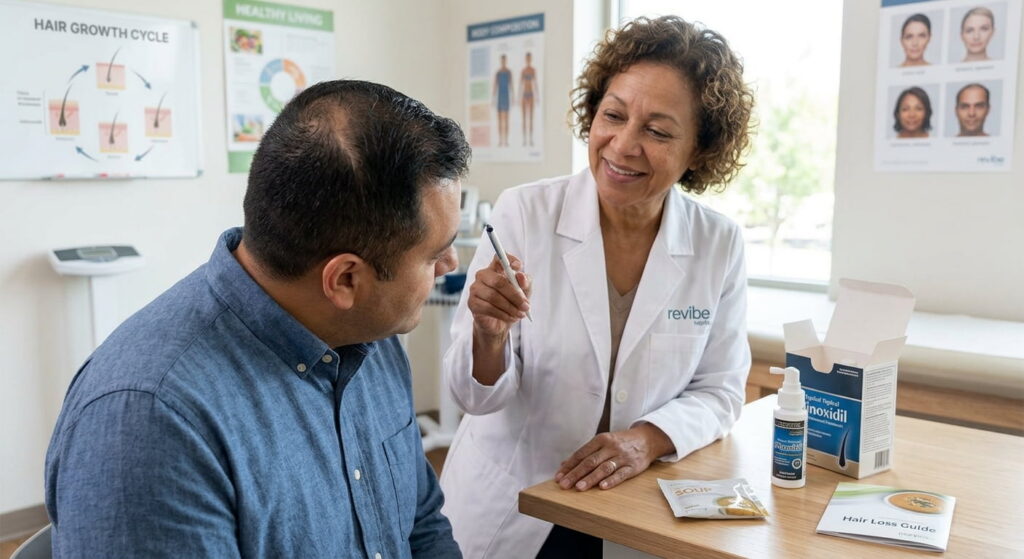
Oral MinoxidilMinoxidil boosts blood flow to hair follicles to stimulate regrowth and thicken thinning hair. It works by increasing blood flow and stimulating hair follicles to shift into a growth phase, helping men with early thinning regain density and slow further loss. Revibe’s providers may include it as a part of a hair loss treatment plan, sometimes paired with finasteride.